Showing posts with label werner herzog. Show all posts

Tuesday, 21 October 2014

The BFI Werner Herzog DVD Collection Disc 2

It is finally time to look at the second disc of the BFI collection box set. Hope you enjoyed part one and potentially found it useful. This time round, there are only two titles to devour. One being my personal favourite Herzog film, and the other being an example of his early television documentary work.
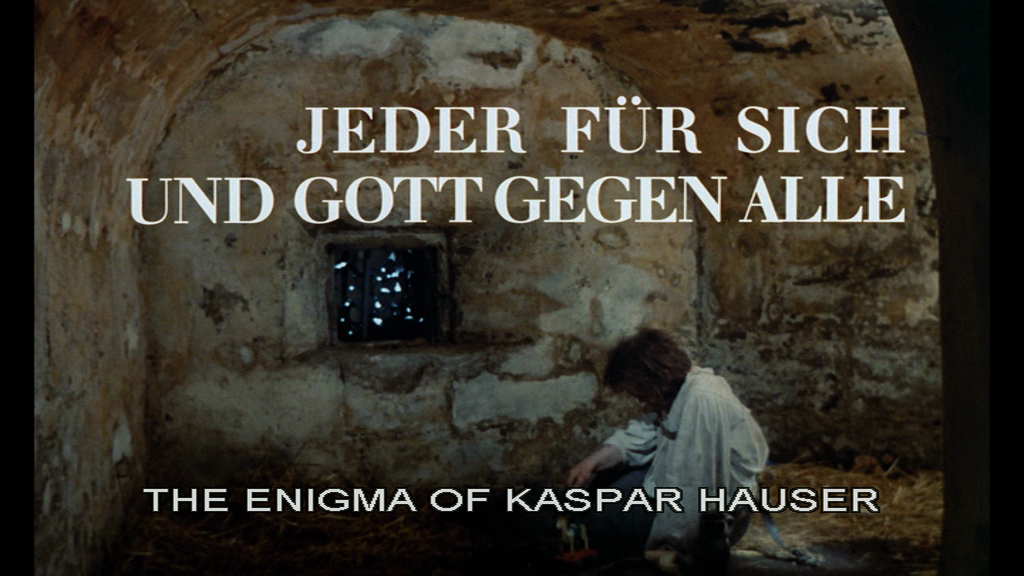
 THE ENIGMA OF KASPAR HAUSER (1974)
(Jeder für such und Gott gegen alle)

“Nothing lives less in me than my life”

Up until his late teens, Kaspar Hauser (Bruno S.) was locked in a cellar by a man in an overcoat and top hat. Devoid completely of any human contact aside from his mysterious captor, Kaspar had only a toy horse to occupy his time. One day however,  Kaspar is finally released by the man, taught some very basic phrases, handed a letter and a Bible, and left in a town square in Nuremberg. Understandably, the locals are intrigued by this mysterious fellow and Kaspar becomes something of a sensation. The locals take pity on him and begin to teach him how to speak and become a respectable citizen. However, it goes sour for Kaspar and he becomes the latest attraction at the local circus. Thankfully, appalled by what he is seeing, a well respected schoolmaster by the name of Herr Daumer (Walter Ladengast) takes Kaspar in to his own care and helps further him in to a well respected and decent human being. After a while, Kaspar begins to question aspects of society and religion. Starts to think for himself and even baffles Daumer and his fellow academics. There is much discussion, debate and philosophising. Not only that, but Kaspar falls in love with music. Unfortunately, he is attacked by the man who held him captive and is then mysteriously stabbed once recovered from the initial attack. Facing death, Kaspar ponders about visions he has had and then slowly fades away.
The film is based on the real Kaspar Hauser, a German youth. Of course, Herzog's adaptation does drift away from the original source material in places. We are meant to sympathise with Kaspar's hardships and celebrate his liberation, in both the literal and metaphorical form. What I feel the story teaches us is that more often than not, those who have different ideas than ourselves, are not always incorrect. I feel it also tells us that we should nurture young minds and not completely disregard ideas and concepts based on the background or position in society of the person who conceives them. I found Kaspar Hauser to be such a touching, yet devastating film. It's an emotional roller coaster  Bruno S. plays Kaspar perfectly. The fact Bruno spent the majority of his youth in mental institutions plays heavily in his portrayal of a character that is not too dissimilar to himself. It's the subtlety in his portrayal that makes it work. It may not be Herzog's most groundbreaking effort, but this is his masterpiece. A great example of taking a real life situation and presenting it in film form. It's a simple film, with a simple message that is also full of childlike wonder. 

HANDICAPPED FUTURE (1971)
(Behinderte Zukunft)

The only other feature on the disc is Herzog's 1971 television documentary that raises awareness about how handicapped people (children in this case) were treated by society in Germany at the time and compares it to how handicapped people are treated in America. Herzog's subjects in the German portion of the documentary are a group of children born with missing limbs. It looks at how they are grouped together in complexes and educated. They are somewhat segregated from society. That being said, it does shine a light on those who are genuinely trying to help and educate the children, but you can't help but feel distress at the fact that they are again, grouped together in one housing complex and not integrated in to society. That becomes in a way, hardly surprising after you hear accounts from the parents and the children themselves of how they have been demonised. We then cut to America and follow a German born university lecturer who has his independence thanks to things like an electronic wheelchair and his place of residency adapted to make his life more comfortable. Overall, this is a simple documentary that has the focus purely on the subject matter. Just like Kasper Hauser, you will be touched and devastated. A very powerful piece of documentary film making.

I think that the two films on the disc go hand in hand. They both deal with how society looks at people who aren't deemed as 'normal'. They both tackle and address important social issues. They also show that just because someone is different, there is nothing stopping them from doing the same things you can achieve. Both films are presented wonderfully, especially the documentary. So far I am adoring this set for the supplemental features alone. On the disc you get a stills gallery, trailer and audio commentary for Kaspar Hauser.


Thank you for joining me once again, here is to disc 3!


You can buy this set from the BFI here, MovieMail here and Amazon UK here. Buying from the BFI directly means you can support the great work they do 100%. You can also pick up a gorgeous looking steelbook of Aguirre here and here.

To find out more about the BFI and some of their release check out their website here.

PDx

Saturday, 27 September 2014

The BFI Werner Herzog DVD Collection Disc 1

Werner Herzog is one of my all time favourite directors. Ever since watching his take on NOSFERATU, I knew I was hooked. Exploring both his fictional and documentary films, you will find a fascinating body of work. Sure, some of his opinions I really don’t agree with (I’m talking about you, INTO THE ABYSS and DEATH ROW) but wether you agree with the content or not, a film with Herzog’s name on it will at least touch you in one way. The British Film Institute recently released a 10 disc box set of some of Herzog’s films. Over the coming weeks (and maybe months) I will be going  through each disc here on the blog. Part review. Part retrospective. Hopefully you will join me on my Herzogian journey. Wether you are a fan of Herzog or a newcomer to his work, I hope you at least get something out of this.

AGUIRRE, THE WRATH OF GOD (1972)
(Aguirre, der Zorn Gottes)

“I am the wrath of God. Who else is with me?”

The year is 1560. A group of Spanish conquistadors and their Indian slaves, lead by Gonzalo Pizarro (Alejandro Repullés), are on a journey through the beautiful, yet deadly terrain of the Andes mountains. They are in search of the kingdom of gold, El Dorado. Unbeknownst to them, it’s a myth created by the newly conquered Indians. Whilst battling the rugged landscape, lives are lost and the expedition comes to a halt. Gonzalo gives Pedro de Ursúa (Ruy Guerra) a week to venture on a head to see what is in store. He makes Don Lope de Aguirre (Klaus Kinski) the second command. What follows is a descent into madness for Aguirre. After members of Ursuúa’s group are killed at the hands of an unseen enemy (amongst other things), becoming increasingly frustrated, Aguirre stages a mutiny and orders the surviving members of the group to join him on finding the mythical riches. Death follows Aguirre round every corner, even at his own hand. Those who survive slowly become feverish and begin to believe everything they see and hear right up until the end, where Aguirre’s small army and sick daughter are stranded on a raft. Everyone dies when they are bombarded with arrows except Aguirre. Insane, isolated and surrounded by death, Aguirre’s raft becomes overrun with monkeys and together, they slowly drift off down the river.
 What a fantastic way to start off this box set. Aguirre, the Wrath of God is nothing short of a masterpiece. On a technical level, the film is beautiful to behold. The breathtaking landscape of the Peruvian mountains and jungle are shot beautifully by Thomas Mauch. The visuals are complimented perfectly by the equally breathtaking (and not to mention haunting) score by Popol Vuh. Herzog’s documentary style overall is nothing short of spectacular. It’s often rough in places, but you get thrown in to the situation playing out on screen. Klaus Kinski steals every scene he is in, and you really get the sense that Kinski doesn’t just believe he is the character Aguirre, but also a God like figure. The electricity in his eyes is almost as ferocious as his performance.The story itself is loosely based on the accounts of Gaspar de Carvajal, a Spanish Domican monk as well as the life of Aguirre himself. It’s a very well written story but overall, it’s Kinski’s performance and the location that really hold the power of this film. Aspiring filmmakers, take note. 

THE UNPRECEDENTED DEFENCE OF THE FORTRESS DEUTSCHKREUZ (1967)
(Die beispiellose Verteidigung der Festung Deutschkreuz)

“Attacking is good, but living is better, even in poverty.”

This short film from 1966 sees four men breaking into and abandoned castle in Deutschkreutz. The castle was the site of a battle between German and Russian soldiers during World War II. The men discover old military uniforms and hardware. They proceed to act out drills, training and eventually battles. Of course, there is no emery and Herzog claims that his film is “A satire on the state of war and peace and the absurdities it inspires.”. The film is essentially silent except for the use of voice over. It’s a very simple film and crude in some regards. You can clearly see Herzog slowly perfecting his craft with this one. It’s a pleasure to see early short work of Herzog.

 LAST WORDS (1968)
(Letze Worte)

“They tell me to say no, but I won’t even say that.”

Last words is a very strange short film indeed. Filmed in two days on the island of Spinalonga island and Crete, Last Words tells the story of the last man to leave Spinalonga. The film is told through accounts of the locals and those involved in relocating the man to Crete. We find out that Spinalonga was a leper colony and that the man, as a result of being forcibly removed, flat out refuses to talk to people. He can seen during the evening however, playing the lyre in a local pub. What makes Last Words so intriguing is its unusual narrative structure. Characters repeat their lines multiple times, often in long takes. Overall, a very unusual and enjoyable short.

PRECAUTIONS AGAINST FANATICS (1969)
(Massnamen gegen Fanatiker)

“I would like to protect the horses from fanatics.”

The next short on the disc is another quirky one that showcases Herzog’s humour. It was also the first film Herzog shot in colour. Basically, the short is about various people at a racetrack in Munich who like to protect horses from fanatical fans. This includes an oddball played by Mario Adorf who demonstrates his favourite punching technique, man who likes to walk horses round a tree for 36 hours and a young boy who, despite the track owners well wishes, wants to protects horses and then eventually resigns to protecting flamingos instead. To top it off, there’s an old man who interferes with each of their interviews and isn’t happy. This short is seen to be believed and is genuinely funny. 

FATA MORGANA (1971)

“In Paradise, even gentiles move mountains.”

The final film included on the first disc isn’t a short film, but Herzog’s bizarre and often unnerving film, Fata Morgana. Shot in the Sahara desert, the film heavily relies on the image. Herzog and his cinematographer Jörg Schmidt-Reitwein capture the vast landscape primarily by long tracking shots. The cinematography throughout is devastatingly effective. To accompany the striking visuals Lotte Eisner (in the German version) provides narration reciting Mayan creation myth. Some pieces of Leonard Cohen's work are also included. Overall, the film deals with idea of mirage (the definition of Fata Morgana) and you will often find yourself seeing things in the background. Aside from the landscape we find abandoned villagers, the corpses of animals and suspicious looking residents of the area. It’s possible to get lost within the film and many aspects are open to interpretation. If one thing is for certain, there is never a dull moment throughout the film. Newcomers to Herzog may want to watch this after viewing some of his more well known and accessible films. On a side note, the making of the film is just as interesting as the film itself and is well deserving of more research.

I'm not going to go in to the technical aspects of the DVD collection until the conclusion in the final post but I can say that all films look and sound brilliant. Extras on the first disc include English and German versions of Aguirre and Fata Morgana as well as commentaries for both. There is also a stills gallery as well as theatrical trailers. Overall, just by looking at the first disc alone, this set is very promising indeed. It's great to see Herzog's earlier short films as well as seeing his more notable efforts presented so well.

I hope you will join me for my second part in this series where I will be looking at the second disc.

You can buy this set from the BFI here, MovieMail here and Amazon UK here. Buying from the BFI directly means you can support the great work they do 100%. You can also pick up a gorgeous looking steelbook of Aguirre here and here.

To find out more about the BFI and some of their release check out their website here.

PDx
Sunday, 17 March 2013

5 Of My Favourite Directors

I have always wanted to do a list like this but at the same time I know I'm going to hate the outcome. To pick only five from a whole list of directors who have had an impact on me personally is a real bitch but hey, I like lists in general and any excuse to get something up on the blog is OK for me. I will tell you now that these are in no particular order and this list could be completely different in a few hours! I'm sure you guys feel me on that one. Let's get started shall we?

Radley Metzger

My first experience with Radley Metzger was The Private Afternoons Of Pamela Mann. After experiencing the intelligence and sophistication of this film I had to see more and look into the world of Radley Metzger. His earlier films are European drenched soft core classics and his later films (under the name Henry Paris) are hardcore classics that are considered the best of the genre. What I love about Radley's work is just how classy and beautiful they are. Don't get me wrong I love 70's roughies where the sex is dirty and the characters are scuzzier than the toilet from Trainspotting but every so often, I do appreciate to be intellectually cared for. Basically, if you like 70's high end Italian cinema you should definitely seek him out. Films to look out for are Camile 2000, The Opening Of Misty Beethoven and Score amongst MANY others.

Umberto Lenzi

To many, Umberto Lenzi could be considered a hack director. This is entirely unfair because aside for being infamous for films like Cannibal Ferox and the fact that he has directed around 65 films over his career Lenzi is a true genius in my eyes. For those who primarily know him for his horror and cannibal stuff I would definitely suggest looking at his poliziotteschi efforts because they really do show just how amazingly talented Lenzi is as a director. You also just have to see the many interviews up on Youtube and you will definitely appreciate how his mind works. I love him for making films that gross me out and make me unintentionally laugh but I adore him for providing me with some of my Italian crime flicks. You should check out The Cynic, The Rat, The Fist, it's one of my personal favourites!


Lucio Fulci

Here is a director who needs know introduction to any of you gore hounds out there. All I need to say about Fulci is he was the king of gore and yeah, some of his films made no sense but man did he know how to make an interesting and entertaining film. I did a whole piece of him a couple of days a go (as of writing this) to celebrate his work on the anniversary of his death. Please check out that post if you are a Fulci fan. Films I would definitely urge you to check out are Conquest and Black Cat.


Michael Haneke

I remember first watching the Americanised shot for shot remake of Funny Games and really not liking it. Needless to say, my first taste of Haneke was a very bitter one. That was one of the many times in my life where I become a dick and disregarded his other work... until I actually watched it and actually see what he was trying to say in his films. After watching a couple of his films in my Film Studies course I thought it was only fair to give him a chance and I picked up the ten film box set from Artificial Eye. After watching more of his work and actually listening to interviews and what he has to say... I was just blown away and slapping myself at the same time. What Haneke does is challenge his audience both during and after most of his films. You are ultimately the person who has to finish the film the way you see it. At first I thought he was just a self obsessed academic who completely had his point lost in ridiculous cinematic moments but now I am finding myself spending hours reassessing the film I just watched. A director that pushes the boundaries but never goes past them just for the sake of it. Be careful what film you start with but highlights from his filmography include The Piano Teacher, Caché and Benny's Video. In fact do yourself a favour and pick up the fantastic box set from Artificial Eye!


Werner Herzog

The thing I love most about Herzog is how he can take a story or personal account, turn it into an almost documentary style film that has a sense of fantasy to it. I know bigger Herzogians than myself will probably be shouting "That's not what he is about!" but that's how his films make me feel. I will admit some of his recent documentary work such as Into The Abyss really doesn't do it for me and just feel like opinionated video essays more than anything. I am of course nitpicking. The term "dangerous filmmaker" gets thrown around a lot but it fits perfectly with Herzog... on a literal scale. The technical feats and dedication to his films Aquirre: The Wrath Of God and Fitzcarraldo shot in Peru are testament to that. Filming in an almost inaccessible location and living off the land to make a film is just astonishing. Herzog really throws himself into his films and doesn't take advantage of the director role. Giving up his rights to luxuries such as trailers and studio lackeys. His early films have a fractured and rough feel to them which appeals to me and talk about breathtaking visuals! Some of the most genuinely beautiful landscapes in cinema can be found in Herzog's films throughout. I have so much time and respect for Herzog and his films touch me in a way most others have never done so. My all time favourite has to be The Enigma Of Kasper Hauser and another one worth checking out is the beautiful Heart Of Glass.

PDx